Settings: Station
Define your station's identity and metadata for streaming servers.
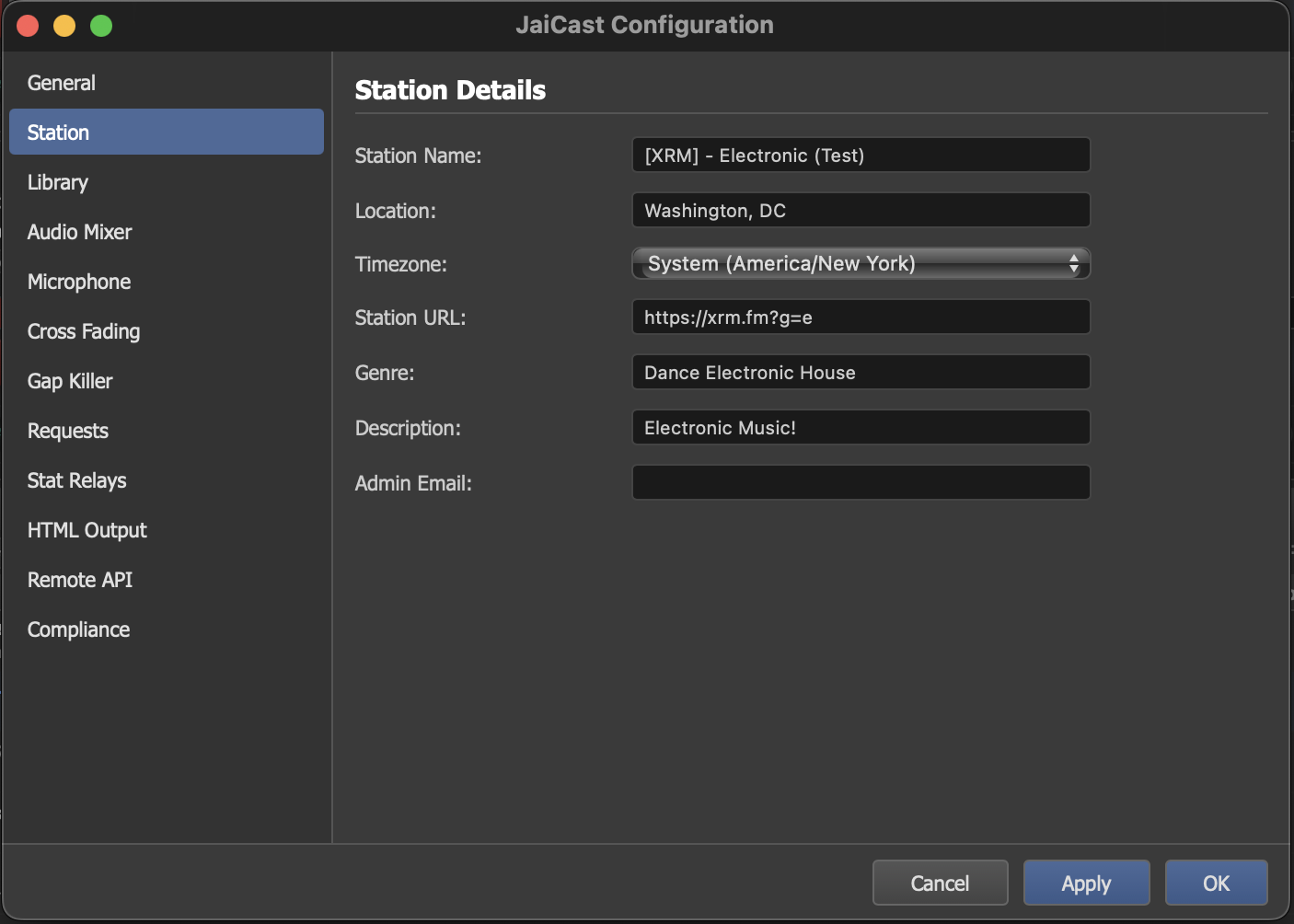
The Station settings panel with identity fields and stream metadata configuration.
Overview
The Station settings page defines the identity of your broadcast station. These values are sent as metadata to streaming servers (Icecast, SHOUTcast, and others) and may be displayed in stream directories, media player interfaces, and listener-facing pages.
Filling in these fields is optional but recommended. A well-configured station profile makes your stream easier to discover and more professional in listener directories.
Station Fields
| Field | Description |
|---|---|
| Station Name | The display name of your station (e.g., "KJAI Radio", "Neon Nights FM"). This appears as the stream title in media players and directories. |
| Location | The geographic location of your station (e.g., "San Francisco, CA" or "Berlin, Germany"). Used by some directories for regional discovery. |
| Timezone | The timezone your station operates in. This affects daypart scheduling, compliance time windows, and log timestamps. |
| Station URL | A URL pointing to your station's website or landing page. Stream directories often display this as a clickable link for listeners. |
| Genre | The primary genre of your station's programming (e.g., "Electronic", "Top 40", "Jazz"). Stream directories use this for genre-based browsing. |
| Description | A short description of your station's format and programming. Keep it concise — one or two sentences is typical. |
| Admin Email | A contact email address for the station administrator. Some streaming servers include this in their admin interfaces. This is not displayed to listeners. |
How Metadata Is Used
When an encoder connects to a streaming server, JaiCast sends these station fields as part of the connection handshake. The exact fields transmitted depend on the protocol:
- Icecast — sends station name, description, genre, URL, and content type as HTTP headers during the source connection.
- SHOUTcast — sends station name, genre, and URL as part of the authentication and configuration sequence.
- HLS/DASH — station metadata is embedded in the manifest files and segment headers.
- RTMP — station name and description are sent as AMF metadata in the stream.
Tip
If you operate multiple encoders with different stream profiles (e.g., a main stream and a low-bitrate mobile stream), they all share the same station metadata. The station identity is global, not per-encoder.
Note
Changes to station metadata take effect on the next encoder connection. If an encoder is already connected, disconnect and reconnect it to push the updated metadata to the server.